Skip to content
Lindner Tech

The 450-Page Technical Handbook by Markus Lindner · Digital Edition

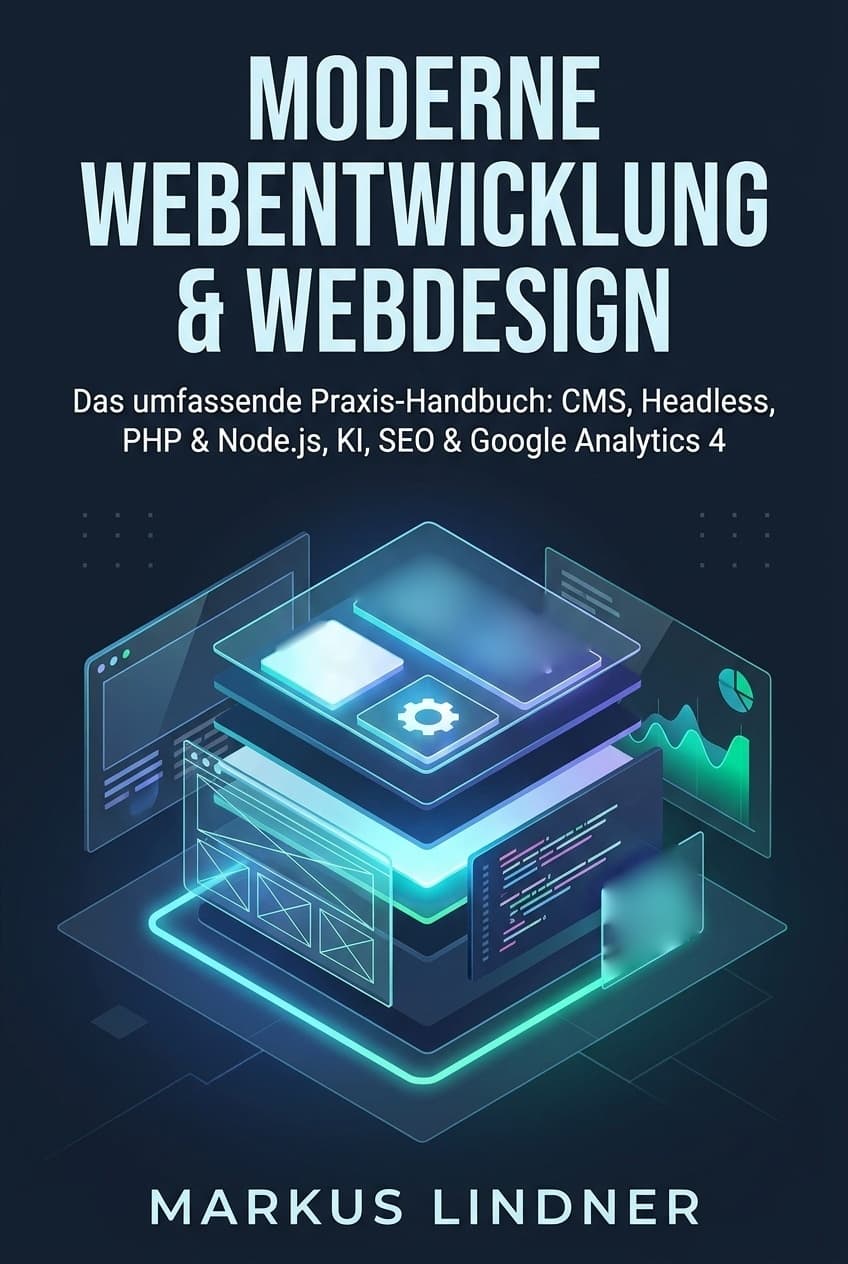
Modern Web Development & Web Design

The Comprehensive Handbook: From the History of the Web, Website Builders, CMS & Headless Architectures to AI Workflows, Technical SEO, Search Engine Algorithms and Google Analytics 4

Wondering whether your next web project should run on a website builder, a classic CMS like WordPress or TYPO3, or a modern headless architecture with Next.js? This 450-page reference work bridges software engineering, UI/UX psychology, legal accessibility (BFSG / WCAG 2.2), artificial intelligence, search engine internals and privacy-first analytics with production-ready code blueprints and 5-year TCO calculations.

  • Digital Edition (PDF · EN & DE)
  • 450 Pages
  • 120 Verified Sources
  • 30+ Code Blueprints Included

Secure direct checkout via Lemon Squeezy (Apple Pay, Google Pay, PayPal, card · incl. VAT invoice & instant PDF download)

Book Specifications at a Glance

Edition
E-Book (PDF · EN & DE)
Length
450 pages
Code Package
30+ blueprints included
Price
€29.90 (incl. VAT)
Checkout
Lemon Squeezy (Instant Download)
Bibliography
120 verified primary sources

Six Core Pillars · 450 Pages of Depth

What You Will Master in This Book

Instead of superficial marketing tips, this handbook provides rigorous architectural comparisons, mathematical foundations and production-ready code patterns.

01Networking, Browser Engine, HTML5, CSS & TypeScript

Web Foundations & Modern Frontend

From the birth of the WWW at CERN across DNS, TLS 1.3, HTTP/3 (QUIC) and the browser rendering pipeline to semantic HTML5, CSS Grid, Subgrid, Container Queries, OKLCH, PHP 8.4 vs. Node.js and TypeScript.

  • HTTP/3 & TLS 1.3
  • Critical Rendering Path
  • CSS Grid & OKLCH
  • TypeScript & Node.js
02Core Web Vitals, Conversion & WCAG 2.2 / BFSG

UI/UX Design, Psychology & Accessibility

Visual hierarchy, eye-tracking patterns, Hick's & Fitts's Law, Atomic Design, Core Web Vitals (LCP, INP, CLS), conversion rate optimisation (CRO) and legally compliant accessibility under the European Accessibility Act (BFSG) and WCAG 2.2.

  • WCAG 2.2 & BFSG
  • Core Web Vitals (INP)
  • CRO & Psychology
  • Design Systems
03Architecture & 5-Year Total Cost of Ownership (TCO)

Builders vs. CMS vs. Headless CMS

Unfiltered architectural and cost comparison between Wix, Squarespace, Shopify, Webflow and Framer, WordPress, TYPO3 and Drupal, and composable headless stacks using Strapi, Directus, Storyblok, Contentful, Sanity, Next.js and Astro.

  • WordPress & TYPO3
  • Next.js & Headless CMS
  • Shopify & Webflow
  • 5-Year TCO Models
04Agentic Coding, Custom RAG Chatbots & Security

Artificial Intelligence & EU AI Act

Use AI productively in web engineering, prevent 'vibe-coding' security vulnerabilities, build GDPR-compliant RAG assistants with vector databases and meet EU AI Act obligations.

  • RAG & Vector Databases
  • Agentic Engineering
  • OWASP LLM Top 10
  • EU AI Act & GDPR
05PageRank, BM25, Schema.org & AI Overviews

Search Engines, SEO & AI Search (GEO)

How search engines actually compute rankings: crawling, indexing, BM25 and the original PageRank formula, BERT and MUM, Technical SEO, JSON-LD knowledge graphs, E-E-A-T and Generative Engine Optimization (GEO) for Google AI Overviews, ChatGPT and Perplexity.

  • PageRank & BM25
  • Technical SEO & JSON-LD
  • GEO & AI Overviews
  • llms.txt & E-E-A-T
06Tag Manager, Server-Side Tagging & Consent Mode v2

Google Analytics 4 & Privacy Compliance

The GA4 event data model, e-commerce dataLayer, Google Tag Manager, Server-Side Tagging, GDPR/TDDDG compliance, Google Consent Mode v2 and cookie-free alternatives such as Matomo, Plausible and Pirsch.

  • GA4 & DataLayer
  • Consent Mode v2
  • Server-Side GTM
  • GDPR & TDDDG

Full Structure · 16 Chapters & 4 Appendices

Inside the Table of Contents

All 16 technical chapters build systematically on one another – complemented by 4 practical reference appendices for daily project work.

Part I

Technical Foundations & Modern Web Architecture

Chapter 1

History and Evolution of the World Wide Web

From the 1989 CERN proposal across Web 1.0/2.0 and the mobile revolution to modern edge computing and AI.

Chapter 2

Networking, Protocols, Browser Internals & Server Runtimes

DNS, TCP/IP, TLS 1.3, HTTP/2 & HTTP/3 (QUIC), Critical Rendering Path and PHP 8.4 (PHP-FPM) vs. Node.js Event Loop.

Chapter 3

Modern Frontend Technologies & Rendering Architectures

Semantic HTML5, CSS Grid/Subgrid, Container Queries, OKLCH, TypeScript as well as SSR, SSG, ISR and React Server Components.

Part II

UI/UX Design, Performance, Accessibility & Conversion

Chapter 4

UI/UX Design Principles, Visual Psychology & Design Systems

Gestalt laws, F- and Z-patterns, Hick's & Fitts's Law, typography, colour contrast and scalable design tokens.

Chapter 5

Responsive Design, Accessibility (BFSG / WCAG 2.2) & Core Web Vitals

Mobile-first architecture, European Accessibility Act compliance, ARIA patterns and optimising LCP, INP and CLS.

Chapter 6

Conversion-Centered Design (CRO) & Sales Psychology

Reducing cognitive friction, applying Cialdini's principles ethically in B2B/B2C, above-the-fold architecture and A/B testing.

Part III

Platform Decisions: Website Builders vs. CMS vs. Headless

Chapter 7

Website Builders & No-Code / Low-Code Platforms

Architecture, limits, vendor lock-in risks and TCO of Wix, Squarespace, Jimdo, Shopify, Webflow and Framer.

Chapter 8

Classic Content Management Systems (WordPress, TYPO3, Drupal)

Monolithic architecture, plugin security, database bottlenecks, caching layers and enterprise governance.

Chapter 9

Headless CMS & Composable Architecture

API-first stacks with Strapi, Directus, Storyblok, Contentful and Sanity paired with Next.js, webhook ISR and edge CDNs.

Chapter 10

The Comprehensive Architecture Decision Guide

Decision matrix, 5 real-world company case studies and complete 5-year Total Cost of Ownership (TCO) models.

Part IV

Artificial Intelligence, Search Engine Internals, SEO, GEO & Analytics

Chapter 11

Artificial Intelligence in Web Design & Software Engineering

Agentic coding, context engineering, avoiding 'vibe-coding' vulnerabilities and automated quality gates.

Chapter 12

AI Integration on Websites: RAG Chatbots, Vector Databases & Law

Building custom RAG systems, embeddings, prompt-injection defence and GDPR / EU AI Act compliance.

Chapter 13

How Search Engines Work: Crawling, Indexing & Ranking Mathematics

Crawl budget, inverted index, TF-IDF, BM25, the original PageRank equation and vector search with BERT and MUM.

Chapter 14

Holistic SEO Practice: Technical SEO, Content, Schema.org & Local SEO

Information architecture, internal link equity, JSON-LD knowledge graphs, E-E-A-T, hreflang and relaunch migration.

Chapter 15

AI Search, Google AI Overviews & Generative Engine Optimization (GEO)

How answer engines (ChatGPT, Perplexity, Gemini) select sources, citation optimisation and llms.txt.

Chapter 16

Google Analytics 4, Tag Management, Server-Side Tracking & Privacy

GA4 event model, dataLayer, Server-Side GTM, Consent Mode v2 under GDPR/TDDDG and Matomo, Plausible and Pirsch.

Appendices A–D

Practical Checklists, Technical Glossary & Verified Bibliography

Appendix A

The 100-Point Master Checklist for Website Launches & Relaunches

Actionable pre-launch checks covering engineering, security, performance, WCAG 2.2, SEO, GEO, legal and analytics.

Appendix B

Comprehensive Technical Glossary (120+ Terms)

Clear definitions from ACID and ARIA to Zero-Click Search.

Appendix C

Verified Scientific & Technical Bibliography

120 double-checked primary sources: IETF RFCs, W3C specs, legislation (GDPR, TDDDG, BFSG, EU AI Act) and foundational papers.

Appendix D

Subject Index & About the Author

Fast lookup across all architectures, algorithms, protocols and case studies.

Practical Extras Included in the Book

30+ Production-Ready Code Blueprints

Concrete implementations in HTML5, CSS, TypeScript, Next.js, PHP 8.4 and Node.js – including a RAG service, JSON-LD generator and consent bridge.

5 Real Business Case Studies with 5-Year TCO

Transparent 5-year total cost calculations for skilled trades, law firms, e-commerce, mid-market B2B portals and SaaS.

100-Point Master Launch Checklist

The complete quality-assurance checklist before any go-live so rankings, speed and legal compliance are never left to chance.

Instant download via Lemon Squeezy (€29.90 incl. VAT): 450-page PDF handbook (English & German) plus code blueprints & VAT invoice.

Buy E-Book & Blueprints (€29.90)

Who It's For

Who Should Read This Book?

Written for everyone who plans, builds or commissions websites and digital platforms on a solid technical and commercial foundation.

Business Owners, Managing Directors & IT Decision-Makers

Understand before hiring an agency which architecture (builder, classic CMS or headless) genuinely fits your business – including realistic 5-year operating costs.

Web Designers, Frontend & Full-Stack Developers

Deepen your command of browser internals, Next.js, Core Web Vitals (INP), accessible code (WCAG 2.2) and secure AI/RAG integrations.

SEO, Marketing & E-Commerce Leads

Master the interplay of Technical SEO, Schema.org, AI answer engines (GEO), Google Analytics 4, Server-Side Tagging and Consent Mode v2.

Computer Science Students & IT Apprentices

A rigorous 450-page desk reference with 120 primary sources connecting computer science theory with real agency engineering.

Markus Lindner – Autor & Gründer von Lindner Tech

About the Author

Markus Lindner

Markus Lindner (born 1998 in Berlin) is a full-stack developer, IT systems administrator and founder of Lindner Tech. Following computer science studies and five years at Siemens AG in Berlin, he graduated as an IHK-certified IT specialist for application development. Alongside managing critical IT infrastructure in Berlin's financial sector, he builds fast Next.js websites, web and mobile apps, database solutions and local AI systems for businesses.

In this 450-page handbook, he shares the exact architectural and engineering practices that power his client projects every day – ready for instant download together with production-ready code blueprints.

Want to Work Directly with the Author on Your Project?

Looking to have your company website, web app, database or local AI system built to the exact standards described in this book? In a free first call we scope your project – and you receive a binding fixed-price quote.

Free consultation0162 8036 905

5.0 on Google · 50 reviews

15 minutes, no obligation · Reply within 24 hours on weekdays